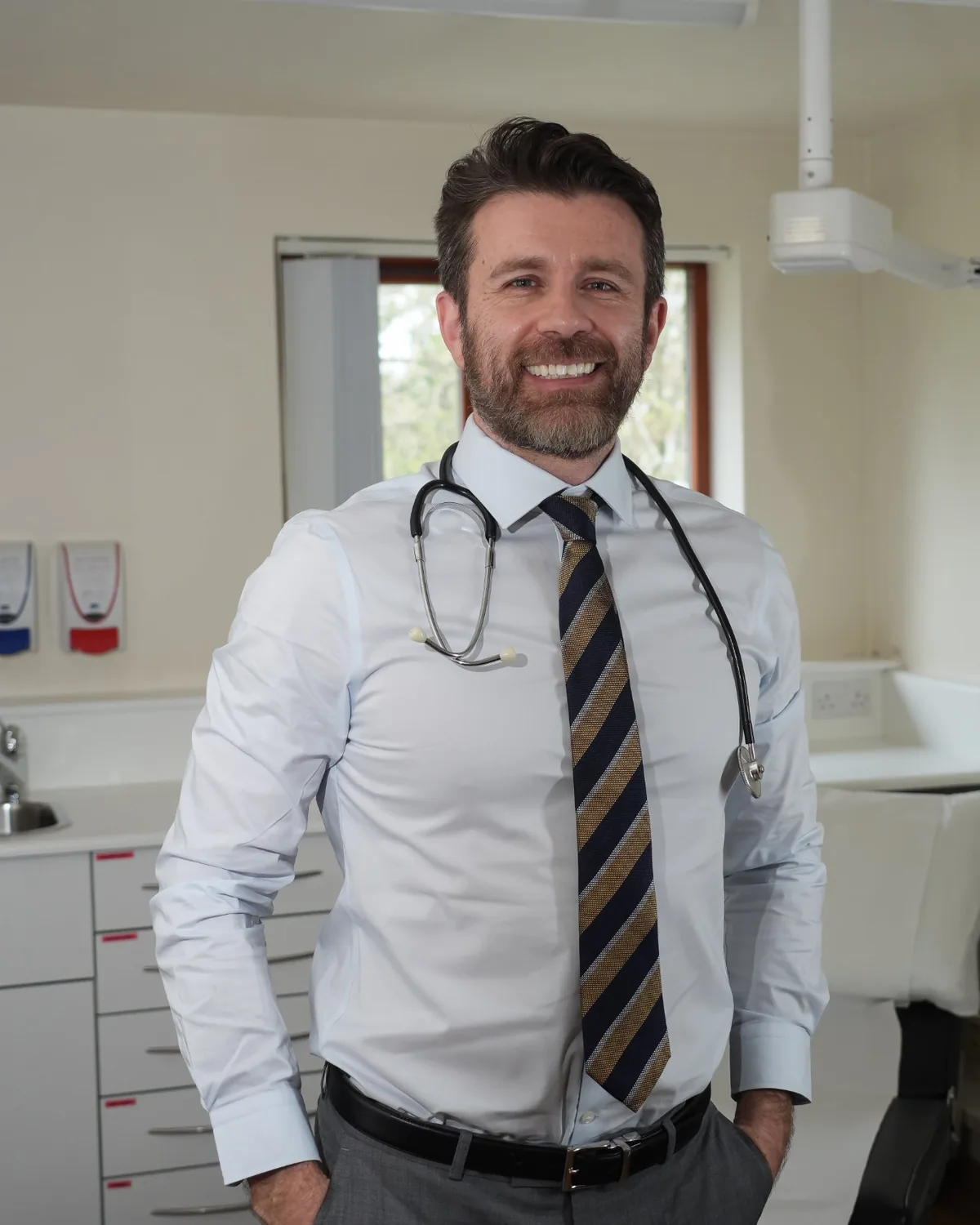
About Dr Dan Reardon
The diagnosis still matters. It is a tool that serves the person, not the other way round. Everything I have done, in sport, in business and in medicine, comes back to that.
Athletics
I was a 400-metre runner. I competed seriously through school and university, until several hamstring tears ended it. What stayed with me was the discipline of sport: results only come from real effort.
Personal training
In 1998 I trained as a personal trainer and opened a training centre in Cardiff, my first business. I became fascinated by sports nutrition and physiology. Medicine came next, out of wanting to understand what the body actually does under stress, load and recovery.
Medical school
One gap was obvious from my first year of clinical training. The NHS had no real framework for performance medicine, only dietitians and generic dietary programmes.
One consultation
During medical school I sat in a consultation with a 14-year-old girl. She was significantly overweight and had gastrointestinal problems. Her father was asleep in the chair.
She already knew she would one day be on medication for blood sugar, heart disease and stroke risk. She had accepted it as the natural course of her life.
That consultation showed me what was wrong with the system, and what needed to be built instead.
Emergency medicine
I graduated into surgical training. After the upheaval in medical training in 2005 I moved to emergency medicine, and that decision has shaped everything since.
Frontline medicine shows you what happens downstream when the system fails, and what a properly built system could prevent. I see it regularly in A&E: people in their fifties on medication that nobody has reviewed in years.
FitnessGenes
I started a fitness and nutrition question-and-answer site, which led to the Science Editor role at Muscle & Fitness. In 2014 I co-founded FitnessGenes, a venture-backed company that personalised training and nutrition from a person's DNA, and I ran it as CEO.
I reviewed more than 3,000 customers' results myself. It was a decade of turning complex biological data into a plan that one particular person could follow.
Back to the NHS
I went back to the emergency department, and I still work there. It is not incidental to what I do privately. You see the consequences of overprescribing, of untreated metabolic disease, and of patients who were never given a clear plan.
Deprescribing
That is why my private practice does one thing. The Independent Medication Review is one doctor, your whole medication list, and the time to go through it properly.
This is not anti-medicine. Emergency medicine and acute pharmacology are essential. What I look at is the long-term medication load that builds up over decades without meaningful review.
Deprescribing isn't the hard part. Staying stable afterwards is. That's what I build for.
The MSc in Mental Health was taken with a specific purpose: to deepen the clinical framework for stopping antidepressants, where psychological and physiological factors are most tightly intertwined.
I hold the British Society of Lifestyle Medicine Diploma in Lifestyle Medicine. I took it to formalise what has been my clinical orientation for two decades. I see the consequences of ignoring nutrition, sleep and movement every shift: patients in their fifties and sixties with preventable conditions, on multiple medications with no coherent plan.
Anyone can help you eat, sleep and train better. Only a doctor can then review your medication in the light of that improvement, make the clinical case for changing it, and take responsibility for the decision. That is the part I do.
NHS A&E doctor. Co-founder and former CEO, FitnessGenes. Chief Medical Advisor, Goodnick. Former Medical Advisor, Cambridge Weight Plan 1:1 (2020–2025). Former Science Editor, Muscle & Fitness.
Featured in the New York Times, Scientific American, GQ, the Daily Telegraph and the LA Times, and on NBC The Doctors, ABC News and BBC Radio London.
"I've been in media since I was 18, and I've watched every health and fitness craze come and go. For 20 years, Dan has been the constant: consistent, credible, and cutting-edge. Long before 'lifestyle medicine' had a name, he was championing longevity with a muscle-first approach we now know is essential. He's always been my go-to for health and fitness."
"Dan is a rare find. He hasn't just studied fitness, nutrition, and supplementation. He's lived it for nearly 30 years. Add the clinical judgement of an emergency doctor and you get lifestyle medicine at a different level: non-judgemental, deeply engaged, and unafraid to challenge the consensus when it counts."
"What sets Dan apart is how he combines elite performance knowledge with a nuanced understanding of different dietary patterns and individual needs. The result is lifestyle medicine that's practical, evidence-led, and exceptional."
"Dan is someone who I trust with my health: nutrition first, then evidence-led supplementation tailored to me. His approach evolves as my needs change, with a level of precision that's rare in this industry. He's consistently ahead of the curve."
"Dan can interpret cholesterol, blood pressure, and hormones, and turn them into everyday actions around stress, sleep, and diet. He builds strength and fat-loss systems that improve real longevity markers, without making prescriptions the default."
"As Chief Medical Officer at Goodnick, Dr Dan Reardon champions a lifestyle-first approach to health, prioritising movement, nutrition, and behaviour change before medication becomes the default solution."
If you want your whole medication list looked at properly, book the Independent Medication Review.
Book the review